How the exam asks
In short
- Assume a normal situation: you drive the white car, the others follow the rules.
- May you? asks whether it is allowed. Must you? asks whether it is required.
- An exception only counts when the picture or the question shows it.
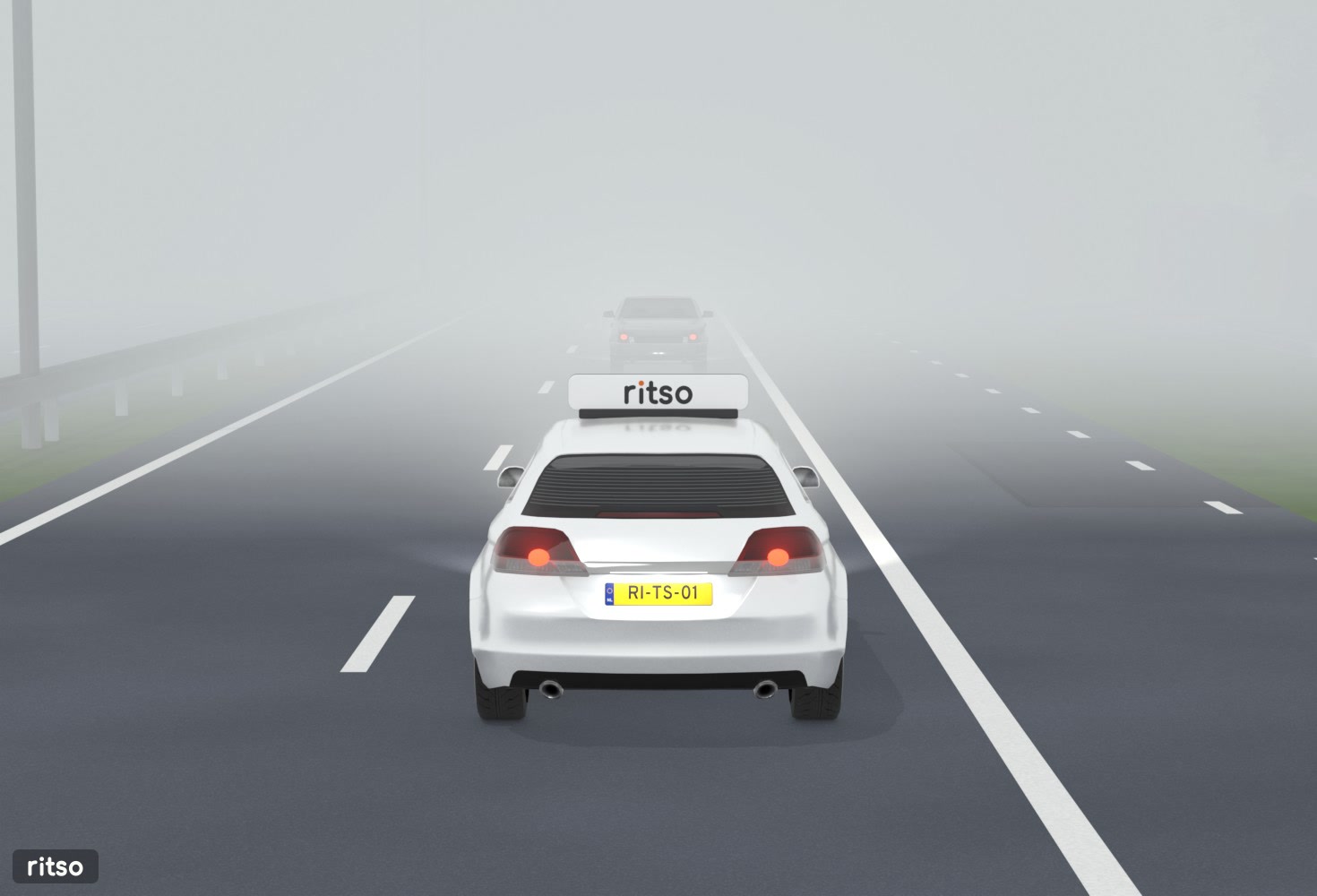
For every question, assume a normal situation. If you see a white car, you are its driver. The other road users follow the rules, including the speed limit. The road and the weather are normal. Only when the picture or the question clearly shows something else is it different.
Show DutchHide Dutch
Read the verb in the question carefully. "Mag je …?" (may you) asks whether the law allows it. The answer is yes, even when it is not required. "Moet je …?" (must you) asks whether the law demands it. If something is only allowed, the answer is no.
Show DutchHide Dutch
| Situation | May you? | Must you? |
|---|---|---|
| Fog, 40 metres of visibility: switch on your rear fog light (mist-achterlicht)A bright red light at the back. Only in fog or snow with less than 50 metres of visibility.All exam words | Yes | No |
| At night on an empty road: your high beam (grootlicht)Headlights that shine far and high. Only at night, and not when you meet or follow someone.All exam words on | Yes | No |
| A child walks to the road without looking: sound your horn | Yes | No |
"Kun je … verwachten?" (can you expect) asks what could happen here. Look at what the picture and the text show, such as rain, ruts in the road or a sign. That is where the answer is, not in what might be out of view.
Show DutchHide Dutch
An exception only counts when the picture or the question shows it. If the white car comes out of an exit (uitrit)Where you drive onto the road from a property, a car park or an erf. You then let all traffic go first.All exam words, the picture shows it. Then the rule for an exit applies. If you see nothing special, the general rule applies.
Show DutchHide Dutch
“There might be a sign just out of view that changes everything.”
No. What is not in the picture or the question isn't there. A sign that counts is one the question shows you. If you see no exception, the general rule applies.
Show DutchHide Dutch
Different from home
In English, "may" can mean "perhaps". In the exam, "mag" always means: it is allowed. "Moet" always means: it is required.
In doubt? Give an answer and set a bookmark. You have plenty of time. At the end, look again at only the bookmarked questions in the overview.